US Prepares AI Ultimatum: Allies May Have to Choose Between America and China
 Written by
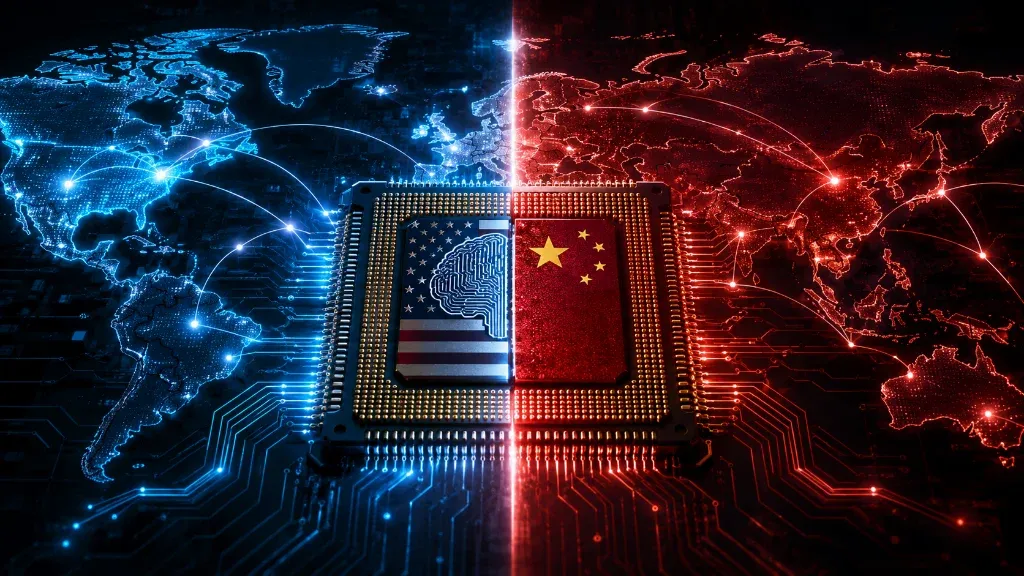
America Draws a Line in the Silicon: Pick the U.S. or China in the Global AI Race
Washington is reportedly preparing to give dozens of partner nations a blunt ultimatum: If you want a place inside America’s artificial-intelligence alliance, you cannot simultaneously join Beijing’s rival camp.
The global AI competition is no longer simply a battle between technology companies building smarter chatbots. It is rapidly becoming a geopolitical showdown—and the United States apparently wants its partners to declare which side they are on.
According to an exclusive Reuters report, the State Department has prepared a draft letter warning countries that participation in China’s emerging AI framework could cost them access to the American-led coalition known as Pax Silica.
Washington’s Message: You Cannot Play Both Sides
Pax Silica was created to strengthen cooperation surrounding AI models, advanced semiconductor chips, critical minerals and the enormous supply chains needed to support them.
Approximately two dozen countries have reportedly joined the initiative, including major American allies such as Japan, Australia and South Korea. Kazakhstan—a potentially valuable source of critical minerals—is currently the only country known to have joined both the American and Chinese initiatives.
That double membership appears to have set off alarms in Washington.
The message from U.S. officials is essentially this: Countries cannot claim to be trusted members of America’s technology ecosystem while simultaneously supporting a competing system designed by Beijing.
The draft letter is reportedly intended for 35 countries that signed an American “AI Opportunity Statement” in June. Those nations expressed support for a shared vision of AI development and cooperation with the United States.
The letter has not yet been officially released, and Reuters reported that it could still be changed. The State Department declined to comment on what it described as a purportedly leaked internal document.
AI Is Becoming the New Cold War Battlefield
Behind all the diplomatic language is a much larger struggle for technological power.
Artificial intelligence could influence nearly every major industry on Earth, including defense, medicine, banking, energy, transportation, manufacturing and cybersecurity. The nation controlling the most powerful AI systems could gain an enormous economic—and potentially military—advantage.
The United States currently possesses many of the world’s leading AI companies, including OpenAI and Anthropic, along with dominant chip designers such as Nvidia. China, however, has been closing the gap with increasingly capable open-weight models that can be downloaded, modified and deployed by developers around the world.
Washington’s strategy appears designed to protect the entire American AI stack—not just the software, but also the chips, data centers, minerals, energy infrastructure and international partnerships supporting it. This follows the broader goals outlined in the White House’s AI Action Plan, which placed international technological leadership and security among its central priorities.
China Is Building Its Own AI Coalition
Beijing is not standing on the sidelines.
Chinese President Xi Jinping recently launched the World Artificial Intelligence Cooperation Organization, presenting China’s technology—and particularly its open-weight AI models—as an alternative to American-controlled systems.
China’s pitch could appeal to developing nations that want affordable access to advanced technology without becoming dependent on American companies or accepting Washington’s political conditions.
That is exactly what makes the situation so complicated. Many countries want American investment and advanced chips while also maintaining strong trade relationships with China. Washington’s reported ultimatum could force those governments into a decision they would much rather avoid.
Critical Minerals Could Decide the Winner
The AI race is often portrayed as a contest involving algorithms and computer code, but physical resources may ultimately prove just as important.
Advanced chips and data-center equipment require access to critical minerals, specialized manufacturing facilities and highly protected international supply chains. China currently holds enormous influence over the mining and processing of several strategically important materials.
Pax Silica is intended to reduce that dependence by connecting the United States with reliable sources of minerals and technology outside China. Members could also gain access to shared investment opportunities involving AI infrastructure and related projects.
Kazakhstan’s mineral reserves therefore make it far more than a symbolic participant. Its decision to join both coalitions highlights the central question now facing countries around the world: Is it possible to benefit from both technology ecosystems, or will Washington and Beijing make neutrality impossible?
The Digital World May Be Splitting in Two
If the reported American policy moves forward, the world could begin dividing into two increasingly separate AI blocs.
- A U.S.-led ecosystem centered on American chips, private AI companies, allied supply chains and tighter security controls.
- A China-led ecosystem built around Chinese infrastructure, widely available open-weight models and Beijing’s international partnerships.
Countries choosing one side could eventually face restrictions when attempting to purchase technology, share research or participate in projects associated with the other.
That would transform AI from a global commercial revolution into something resembling a digital Cold War—complete with competing alliances, protected supply chains and technological spheres of influence.
The Bottom Line
The United States appears ready to make loyalty a requirement for membership in its AI coalition. Washington believes allowing countries to participate in both systems could provide China with access to resources, knowledge and partnerships capable of strengthening its economic and military position.
But forcing nations to choose could also create resentment, disrupt trade and accelerate the construction of a completely separate Chinese technology ecosystem.
The battle for AI supremacy has officially moved beyond Silicon Valley. It is now being fought in diplomatic meetings, mineral deals and government alliances—and every country may soon be asked the same uncomfortable question:
Whose artificial-intelligence future do you want to be part of?
Comments
No comments yet. Be the first to comment!
Leave a Comment