Unreleased Claude AI Research Model Reportedly Makes Progress on the Riemann Hypothesis
 Written by
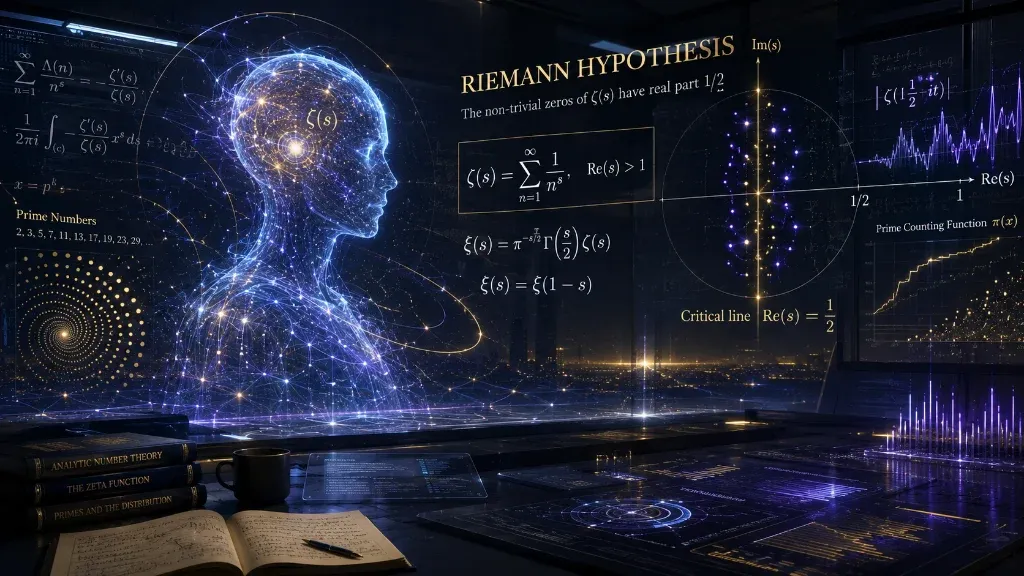
Claude’s Secret Research Model Is Reportedly Making Moves on the Riemann Hypothesis — Math’s $1 Million Monster
Anthropic may have another math beast cooking behind closed doors — and this one is reportedly taking swings at one of the most terrifying problems in mathematics.
Buzz surrounding Claude’s next-generation research capabilities is getting seriously interesting, with talk that an unreleased Claude research model has been helping mathematicians push forward work connected to the legendary Riemann Hypothesis.
Now, before everybody starts spending that million-dollar prize money ... Claude has NOT been confirmed to have solved the Riemann Hypothesis. Not even close, officially.
But the fact we're even having this conversation? Yeah ... that's pretty wild.
Claude Is Getting Freakishly Good at Research Math
Anthropic's recent models have already shown serious muscle on research-level mathematics. The company's published Claude system cards document evaluations involving difficult mathematical reasoning tasks designed to go far beyond the stuff you'd find on a normal school exam.
One of those evaluations is called RiemannBench — despite the name, it isn't literally a test asking Claude to solve the Riemann Hypothesis. It's a collection of private, research-level math problems created to see whether frontier AI models can reason through the kind of mathematics professional researchers actually deal with.
And Claude's newer models have been posting increasingly strong results.
That matters because AI's role in mathematics is changing fast. We're moving from, "Hey Claude, explain this theorem," to, "Hey Claude, can you help discover something mathematicians didn't already know?"
And Then There's The Riemann Hypothesis...
The actual Riemann Hypothesis has been sitting undefeated since Bernhard Riemann proposed it in 1859.
In extremely simplified terms, it deals with the mysterious distribution of prime numbers and the zeros of something called the Riemann zeta function. Proving it would have enormous consequences across number theory.
It's such a gigantic deal that the Clay Mathematics Institute made it one of its Millennium Prize Problems and put a $1 million prize on a valid solution.
And yes ... that money is still sitting there.
Don't Pop The Champagne Yet
This is where things need a giant flashing CAUTION sign.
There is currently no publicly verified proof showing Claude — released or unreleased — has solved the Riemann Hypothesis, and claims that a private research model has made meaningful new progress would need to be examined by actual mathematicians before anybody starts rewriting the history books.
That's especially important with AI-generated mathematics. A model can produce something that looks unbelievably convincing while quietly slipping a bad assumption into line 47 and sending the entire proof straight off a cliff.
Mathematics doesn't care how confident the chatbot sounds. The proof either works ... or it doesn't.
But AI Is Starting To Knock On Some Very Big Doors
Here's what makes the story juicy: frontier AI has already started participating in legitimate mathematical research, and researchers are increasingly testing models on problems that would've sounded completely ridiculous for a chatbot just a few years ago.
Claude models have recently attracted attention for research-level mathematical reasoning, while AI systems more broadly have begun helping researchers search for proofs, generate conjectures and test possible mathematical constructions.
That doesn't mean we're waking up tomorrow to "CLAUDE SOLVES RIEMANN."
But if an unreleased research model really is producing useful new ideas connected to one of mathematics' most notorious unsolved problems, that's arguably the bigger story anyway.
Because the AI revolution may be moving past writing emails, generating code and making pictures of cats wearing sunglasses.
It may be starting to do actual science.
And somewhere, Bernhard Riemann is probably wondering why it took a giant pile of GPUs to finish his homework.
Comments
No comments yet. Be the first to comment!
Leave a Comment