OpenAI’s $750 Billion AI Spending Spree: Inside Its Massive Data Center Expansion
 Written by
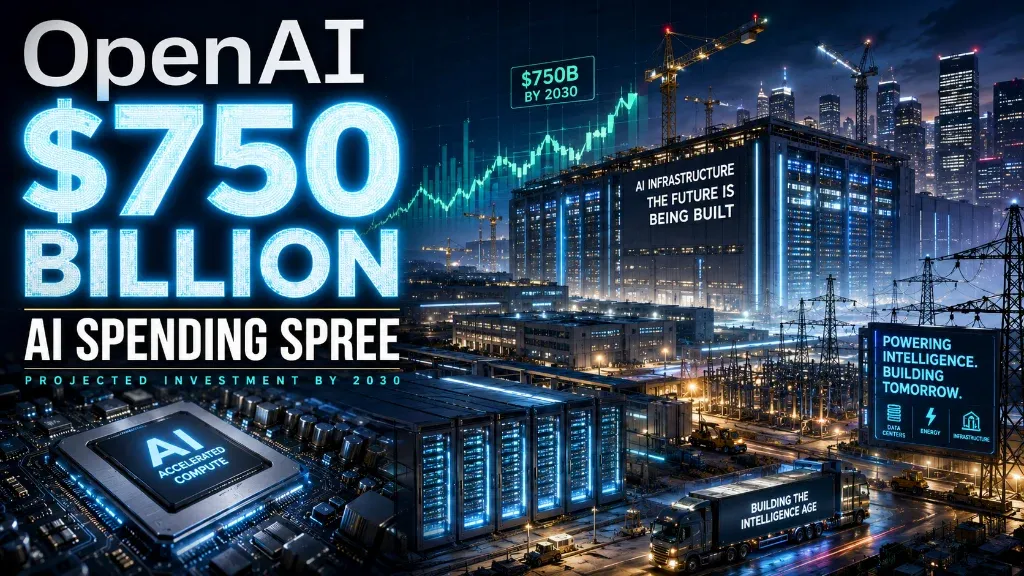
OPENAI’S SPENDING PLAN HITS $750 BILLION
Sam Altman Goes Full Mega-Builder in the High-Stakes AI Arms Race
OpenAI is taking “go big or go home” to a whole new level—with the company’s projected spending on computing power reportedly ballooning to an eye-watering $750 billion through 2030.
Yes, billion with a “B”—and enough zeroes to make even Silicon Valley’s biggest spenders check their bank balances twice.
According to a new report from The Wall Street Journal, OpenAI has increased its projected cloud and computing expenditure from roughly $600 billion earlier this year to approximately $750 billion by the end of 2030.
Important distinction: OpenAI has not already burned through $750 billion. This is the company’s projected spending plan and collection of infrastructure commitments over the coming years.
A VERY EXPENSIVE BRAIN
Running artificial intelligence isn’t cheap. OpenAI needs enormous numbers of advanced computer chips, sprawling data centers, massive cooling systems and enough electricity to power entire cities.
Every time somebody asks ChatGPT to write an email, create computer code or settle an argument about whether a hot dog is technically a sandwich, powerful servers somewhere have to crunch the request.
Now multiply that by hundreds of millions of users—and add the staggering resources required to train the next generation of AI models.
The company is reportedly locking down long-term computing capacity through major relationships with cloud and infrastructure giants, including Microsoft, Oracle and Amazon Web Services.
WELCOME TO PROJECT CAMELLIA
The first headline-grabbing piece of OpenAI’s newest construction push is a massive Georgia data-center development known as Project Camellia.
OpenAI says it is designing and developing the facility in Effingham County, near Savannah. The company has contracted with Georgia Power for 3.2 gigawatts of electricity, which is expected to be delivered in phases between 2028 and 2032.
The initial investment in the campus is reportedly expected to reach approximately $20 billion.
OpenAI provided additional details about the project in its official announcement, Building AI Infrastructure With the Effingham County Community.
The company says it plans to cover the infrastructure and electrical-service costs connected with the development, while also promising that residential customers will not be forced to subsidize its enormous appetite for power.
STARGATE WAS JUST THE OPENING ACT
The latest spending projection follows OpenAI’s earlier unveiling of Stargate, an ambitious infrastructure program originally announced with plans to invest as much as $500 billion over four years.
That initiative was introduced as a partnership involving OpenAI, SoftBank, Oracle and investment firm MGX. The official Stargate announcement said the project would begin by deploying $100 billion toward new American AI infrastructure.
But OpenAI’s ambitions now appear to be stretching beyond individual partnerships. Project Camellia represents the company taking a more direct role in designing and developing the physical facilities behind its technology.
THE $750 BILLION QUESTION
The big mystery is whether OpenAI’s revenue can grow quickly enough to support such an enormous financial commitment.
The company is betting that demand for AI assistants, business tools, automated workers and increasingly advanced models will continue exploding throughout the decade.
Supporters see the spending as the digital equivalent of building railroads, power grids and interstate highways before the full economic payoff becomes obvious.
Critics see something very different: a historic spending spree dependent on relentless investment, cheap access to capital and customers remaining willing to pay for increasingly expensive AI services.
Either way, OpenAI is no longer behaving like a scrappy technology startup.
It’s behaving like a cloud provider, an energy company and a construction empire—all rolled into one.
AI’S BIGGEST HIGH-ROLLER
The race for artificial-intelligence dominance has already pulled Microsoft, Google, Amazon, Meta, Oracle, Nvidia and dozens of other companies into a worldwide battle for chips, land and electricity.
OpenAI’s new $750 billion projection shows just how costly that battle may become.
Sam Altman and company are placing one of the largest technology bets in history—and they’re betting that tomorrow’s economy will need nearly unlimited amounts of artificial intelligence.
Now comes the hard part: making sure the machines produce enough money to pay the electric bill.
Comments
No comments yet. Be the first to comment!
Leave a Comment