OpenAI Launches Codex Micro: New $230 AI Keypad for Developers
 Written by
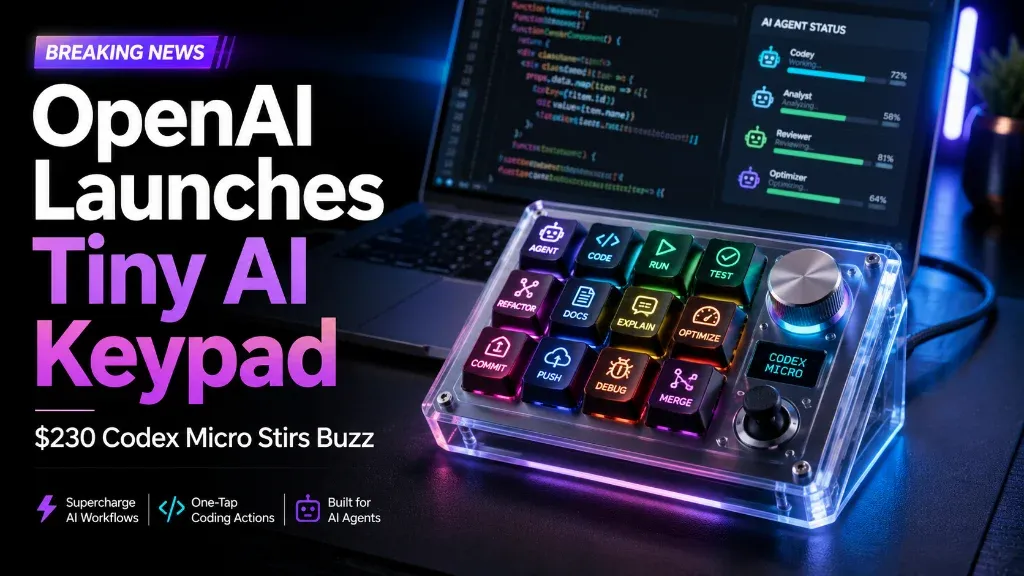
OpenAI Drops Its First Hardware Gadget — and It’s a Tiny $230 Keypad for Bossing Around AI
OpenAI is officially putting its fingers on some actual hardware — but honey, it’s probably not the futuristic ChatGPT gadget you were expecting.
The artificial-intelligence powerhouse unveiled the Codex Micro, a tiny, colorful desktop keypad designed to help programmers control and monitor their AI coding agents without constantly clicking through a mountain of windows.
And yes, this adorable little command center comes with a very grown-up price tag: $230.
OpenAI Said, “Give the AI Agents Their Own Remote”
Released on July 15, the Codex Micro was developed through a limited-edition collaboration between OpenAI and boutique keyboard manufacturer Work Louder.
The square device includes 13 mechanical switches, customizable command buttons, a rotary dial, a touch sensor and a tiny joystick. It can connect to Mac or Windows computers using either Bluetooth or USB-C.
Basically, it looks like someone shrank a mechanical keyboard, gave it mood lighting and promoted it to middle management.
Users can check out the device on OpenAI’s official Codex Micro product page.
Those Flashing Lights Actually Mean Something
The translucent “Agent Keys” aren’t only there to make your desk look like a miniature nightclub. Their RGB lighting changes to show what different Codex agents are currently doing.
A glance at the keypad can reportedly tell users whether an agent is thinking, running, waiting or finished — potentially saving developers from repeatedly opening individual chats to check on their AI workers.
Other programmable buttons can handle frequently used actions such as:
- Accepting or rejecting proposed changes
- Starting a new Codex conversation
- Activating push-to-talk
- Switching between active agent tasks
The miniature joystick can launch common workflows, including reviewing a pull request, debugging an error or refactoring code.
Then there’s the dial — and this might be the most gloriously nerdy feature of the entire device. Turning it adjusts the AI agent’s reasoning level, allowing users to keep things speedy for simple jobs or request more processing for complicated work.
It’s Not Just a Keyboard — It’s an AI Control Room
The Codex Micro is meant to work alongside OpenAI’s Codex platform, which lets people assign lengthy coding and computer-based tasks to AI agents.
Instead of typing every instruction into one chatbot and waiting for it to finish, Codex users can run several agents in parallel — with different agents potentially building features, checking code or investigating problems at the same time.
The new keypad turns that increasingly complicated digital workflow into something physical. Think of it as a tiny control panel for supervising a room full of invisible AI employees who never ask where the coffee machine is.
That $230 Price Is Already Raising Eyebrows
The Codex Micro includes 32 additional icon keycaps and is available with either clicky or silent mechanical switches. Its body combines CNC-machined polycarbonate and aluminum, giving it a more premium build than the average plastic shortcut pad.
Still, $230 for a handful of buttons, a joystick and a dial is bound to spark debate — especially when less expensive programmable macro pads are already widely available.
What customers are really paying for is the direct Codex integration, including live agent-status lighting and physical controls mapped specifically to OpenAI’s software.
Translation: This isn’t for someone who occasionally asks ChatGPT to fix a spreadsheet formula. It’s aimed at power users juggling enough AI agents to need an air-traffic controller.
And No — This Isn’t the Mysterious Jony Ive Device
Before everyone starts screaming that OpenAI finally released its long-rumored personal AI companion, slow down.
The Codex Micro is separate from the broader consumer hardware project associated with former Apple design chief Jony Ive. That mysterious product has reportedly been imagined as a more general-purpose, screen-free AI device rather than a specialized accessory for programmers.
So, no, OpenAI hasn’t unveiled a ChatGPT phone, an AI necklace or a talking robot bestie — at least not yet.
Small Keypad, Bigger Message
The Codex Micro might be a niche product, but its arrival sends a much larger signal: OpenAI wants its technology to move beyond websites and apps and start occupying physical space on people’s desks.
For developers already using multiple Codex agents, the gadget could provide a faster and more satisfying way to control them. For everybody else, it may look like a very expensive collection of glowing buttons.
Either way, OpenAI has officially entered the gadget game — and apparently, the first step toward our AI-powered future is a tiny keyboard with a joystick.
Comments
No comments yet. Be the first to comment!
Leave a Comment