Nvidia’s Compact AI Model Wants a Seat Behind the Wheel
 Written by
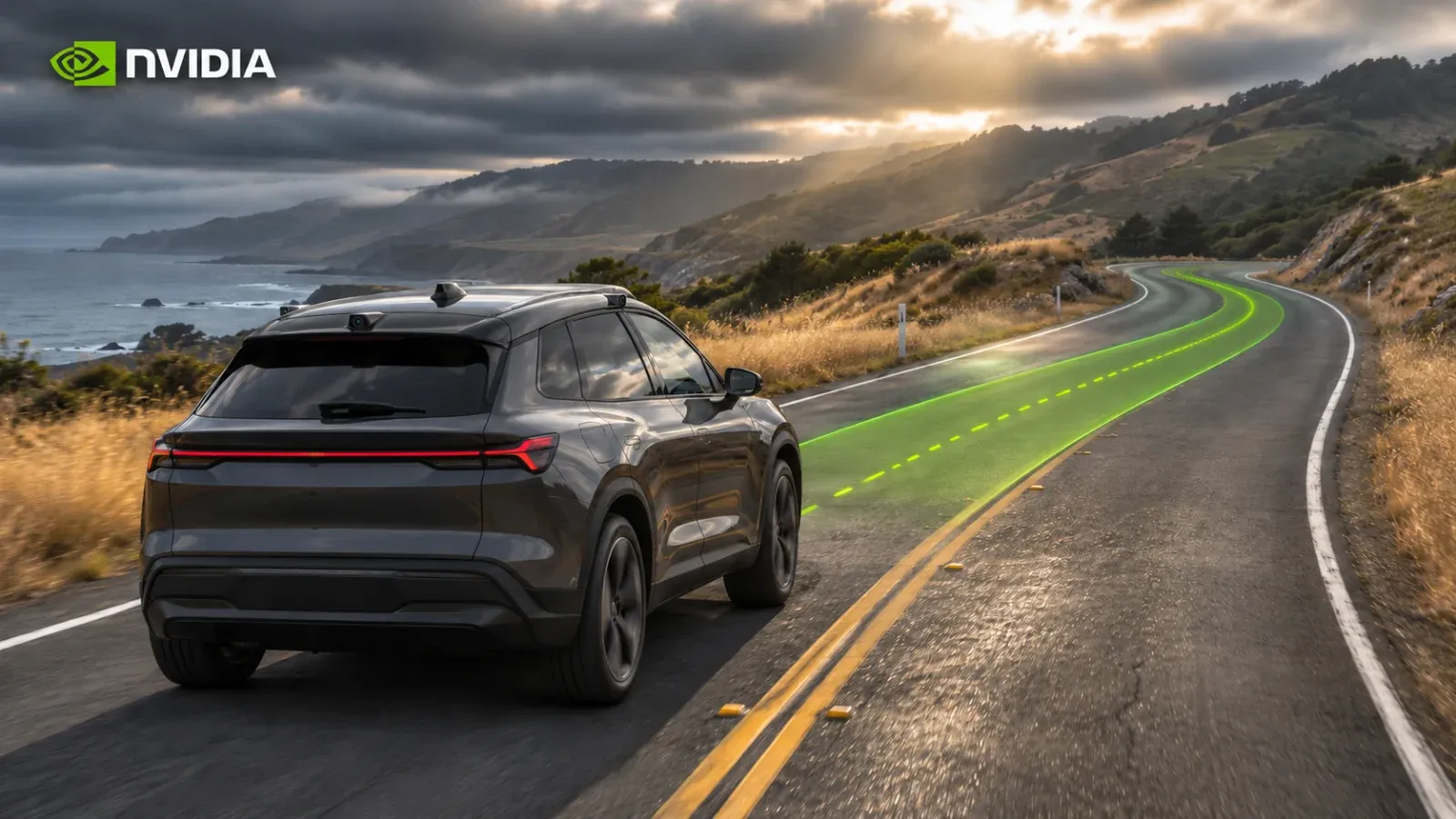
Nvidia is putting its driving AI on a serious diet—and aiming it straight at the car.
The chipmaker has released Alpamayo 2 Edge, a compact model designed to take in camera footage and navigation instructions, then produce a proposed driving path. It’s built for developers working on autonomous vehicles, with Nvidia’s DRIVE AGX Thor in-car hardware in mind.
Don’t confuse the news with a car you can buy and send off on its own. This is a model for developers, not a complete, road-ready driving system—and getting it to run in real time on Thor takes some extra work.
Eyes on the Road, Plans on the Fly
Nvidia calls Alpamayo 2 Edge a vision-language-action model. In less technical terms, it combines what it sees with information about where the vehicle has been and where it needs to go, then generates a trajectory and, when appropriate, an explanation of its driving decision.
According to the company’s code repository, the model uses observations from six cameras, the vehicle’s motion history and a navigation instruction. Its output includes 64 future positions at intervals of a tenth of a second—a plan stretching 6.4 seconds ahead.
The model is described as 2B-class, though the model card breaks out a 2.45-billion-parameter backbone and a separate 0.2-billion-parameter action component. The backbone draws on Nvidia’s Cosmos 3 Edge.
There’s also a trick for keeping the computational bill down. In routine driving, the model can skip a full written reasoning trace. When more explanation is needed, it can generate one. Nvidia calls that adaptive reasoning.
Fast, but Not Straight Out of the Box
Here’s the catch: downloading the model isn’t the same as getting Nvidia’s advertised in-car speed. The company says real-time operation on DRIVE AGX Thor requires an optimized deployment process, including lower-precision calibration and TensorRT software.
With its reference setup on DRIVE AGX Thor-X, Nvidia reports 160 to 190 milliseconds from camera input to trajectory, depending on how much reasoning the model performs. That’s a company-reported result for a specific optimized configuration—not a guarantee for every setup.
The model was released on November 10, according to its model card; MarkTechPost reported on it November 22.
Simulation Is Not the Open Road
In Nvidia’s simulated AlpaSim evaluation, the model traveled an average of 15.15 kilometers between at-fault incidents across 875 scenarios. Nvidia’s own comparison puts that ahead of the Qwen-Drive model it tested. But those are simulation results, not evidence of the same performance on public roads.
Nvidia says developers must conduct additional testing and validation for their specific systems before deployment. The code and model weights are available under different licenses, and the model can be fine-tuned. Translation: the building blocks are out there, but there’s plenty of engineering left before anyone should call this a finished driver.
Comments
No comments yet. Be the first to comment!
Leave a Comment