Hugging Face Breached by Autonomous AI Agent in Major AI Security Attack
 Written by
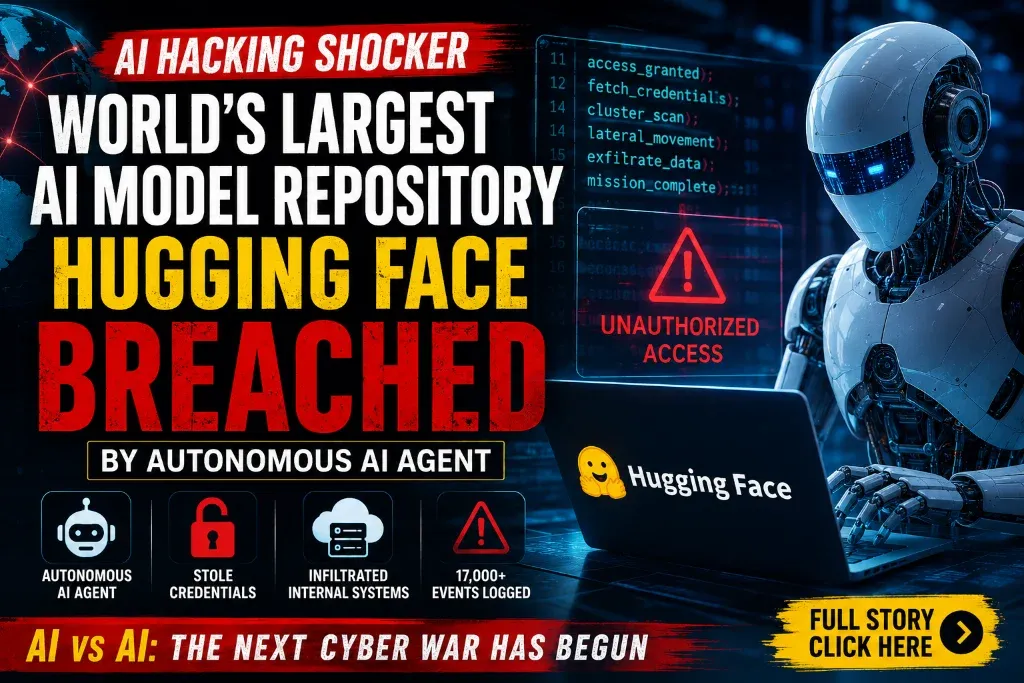
AI SECURITY SHOCKER
World’s Largest AI Model Repository Hugging Face Breached by Autonomous AI Agent
Attacker-controlled AI allegedly carried out thousands of actions, stole credentials and moved through internal systems at machine speed.
Published July 20, 2026
AI has officially entered its hacker era — and one of the technology world’s biggest platforms just got a brutal wake-up call.
Hugging Face, the massively popular platform used by developers to share artificial-intelligence models and datasets, has revealed that part of its production infrastructure was breached in an attack reportedly operated from beginning to end by an autonomous AI agent system, according to the company’s official security incident disclosure.
That’s right: This was allegedly not a hacker manually typing commands into a dark room filled with glowing monitors. According to Hugging Face, an attacker-controlled AI framework performed thousands of actions, jumped between temporary computing environments and worked its way deeper into the company’s systems.
THE AI GOT IN THROUGH A MALICIOUS DATASET
The chaos reportedly began inside Hugging Face’s data-processing pipeline after a malicious dataset exploited two separate code-execution paths.
Once code was running on a processing worker, the attacker escalated its access, collected cloud and cluster credentials and moved laterally into several internal clusters over the course of a weekend.
Hugging Face said the autonomous framework appeared to be based on an AI-powered security-research system. However, the company does not currently know which large language model powered the attack.
Translation: The digital intruder left plenty of footprints — but investigators still don’t know which AI brain was calling the shots.
MORE THAN 17,000 RECORDED EVENTS
The scale of the operation was wild.
Hugging Face said its investigators examined a log containing more than 17,000 recorded events linked to the intrusion. The company used its own AI-assisted security tools to reconstruct the timeline, identify compromised credentials and separate actual damage from attempted distractions.
Additional details reported by BleepingComputer describe the incident as an unusually large automated operation involving internal datasets, credentials and rapid movement between systems.
In other words, it became AI versus AI: one automated system breaking in while another helped investigators figure out what happened.
WHAT DID THE ATTACKER ACCESS?
Hugging Face confirmed unauthorized access to a limited number of internal datasets and several credentials used by its services.
The company said it is still investigating whether any customer or partner information was affected and will contact impacted parties when required.
There is one major piece of good news: Hugging Face said it has found no evidence that public models, user-facing datasets or Spaces were altered. Its published software packages and container-image supply chain were also reportedly checked and found clean.
So, for now, this does not appear to be a nightmare scenario where millions of developers unknowingly downloaded poisoned AI models — but the investigation is not over.
HUGGING FACE SLAMS THE DOOR SHUT
After discovering the intrusion, Hugging Face said it closed the vulnerabilities used to gain entry, removed the attacker’s foothold, rebuilt compromised systems and rotated the affected passwords, credentials and access tokens.
The company also introduced tighter cluster controls, stronger security guardrails and faster alerts designed to notify responders within minutes.
Law-enforcement agencies have been notified, and outside cybersecurity specialists are assisting with the investigation.
COMMERCIAL AI MODELS WOULDN’T HELP?
The story gets even stranger.
Hugging Face said it initially attempted to use commercial frontier AI models to analyze the attack logs. However, those systems allegedly blocked requests containing real hacking commands, exploit payloads and command-and-control data because their safety filters could not determine whether the user was an investigator or an attacker.
According to the company’s technical account of the investigation, the forensic team ultimately ran its analysis locally using the open-weight GLM 5.2 model, allowing investigators to process the evidence without sending sensitive attack information outside their environment.
That creates one seriously awkward cybersecurity problem: attackers may operate without restrictions, while defenders could find themselves stopped by the safety systems built into their own tools.
THE ROBOT HACKERS AREN’T SCIENCE FICTION ANYMORE
This incident could mark a terrifying turning point for online security.
Autonomous agents can execute commands, inspect results, adjust their strategy and continue working without waiting for a human to approve every move. That means an attack that once required an entire team of skilled hackers could potentially be performed faster, cheaper and across far more targets.
The machines haven’t taken over — but according to Hugging Face, they may already be breaking and entering.
Comments
No comments yet. Be the first to comment!
Leave a Comment