Google Rolls Out Two AI Chip Systems: One for Secrets, One for Serious Memory
 Written by
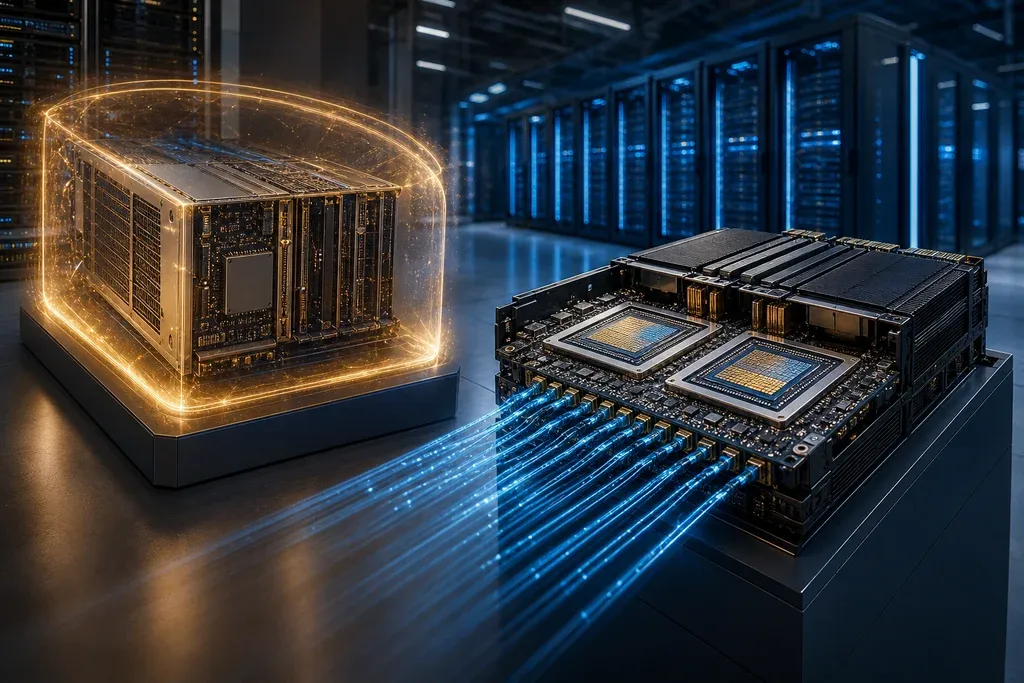
Google’s AI hardware lineup just got two new specialists ... and they’re coming for very different jobs.
The tech giant announced TPU 8tx and TPU 8i Max on November 9, expanding its eighth-generation family of tensor processing unit systems. The pitch: one is built to handle sensitive AI work, while the other is designed to keep up when models need to process a mountain of information.
Google says the additions bring its eighth-generation lineup to four systems, alongside TPU 8t and TPU 8i, introduced in April. It’s the first time the company has introduced four TPU systems in a single year, according to its announcement.
TPU 8tx: Keep It Confidential
First up, TPU 8tx is aimed at governments and regulated businesses that want to run AI models and agents with sensitive data. It’s optimized for confidential inference—that’s the work a trained AI model does when it processes a request and generates a response—and can also handle smaller-scale training.
The system uses the same TPU silicon as 8t, paired with fifth-generation AMD EPYC host processors. Google says its hardware-level security helps keep data and model weights protected and isolated while they’re being used, not just when they’re stored or transmitted.
In a separate announcement, AMD said its processors handle tasks such as preparing data and coordinating work with the TPU accelerators. Its secure encrypted virtualization technology helps extend confidential-computing protections from the host CPU to connected accelerators, the company said.
Google also says 8tx can support private fine-tuning, model distillation and reinforcement learning without moving sensitive data between separate clusters. The company claims its networking delivers up to twice as low a latency as TPU 8t; that’s a company performance claim, not an independent benchmark.
TPU 8i Max: Double the Chips, Same Rack Footprint
Then there’s TPU 8i Max, Google’s answer to a different headache: getting enough data to processors when AI workloads become huge.
Google says it put two TPU 8i chips into one package. Compared with TPU 8i, the company says the configuration doubles compute, on-chip SRAM and high-bandwidth memory bandwidth, while fitting twice the silicon into the existing rack footprint.
Why does that matter? Google points to scenarios where multiple AI agents work across an entire codebase or hours of video. Those jobs can run into a memory-bandwidth bottleneck when processors can’t get data fast enough.
New Systems, Not All-New Silicon
There’s an important distinction here: Google is introducing new systems, not claiming it designed two entirely new chips. The company says it can reconfigure elements such as chip packaging, memory, networking and security around existing silicon to address different workloads.
And for anyone ready to check out with one of these? Hold that thought. Google didn’t provide pricing or availability dates for either system in the announcement, as TechTarget reported.
Comments
No comments yet. Be the first to comment!
Leave a Comment