Claude Opus 5 Benchmarks Explained: How Fast, Powerful, and Affordable Is Anthropic’s New AI Model?
 Written by
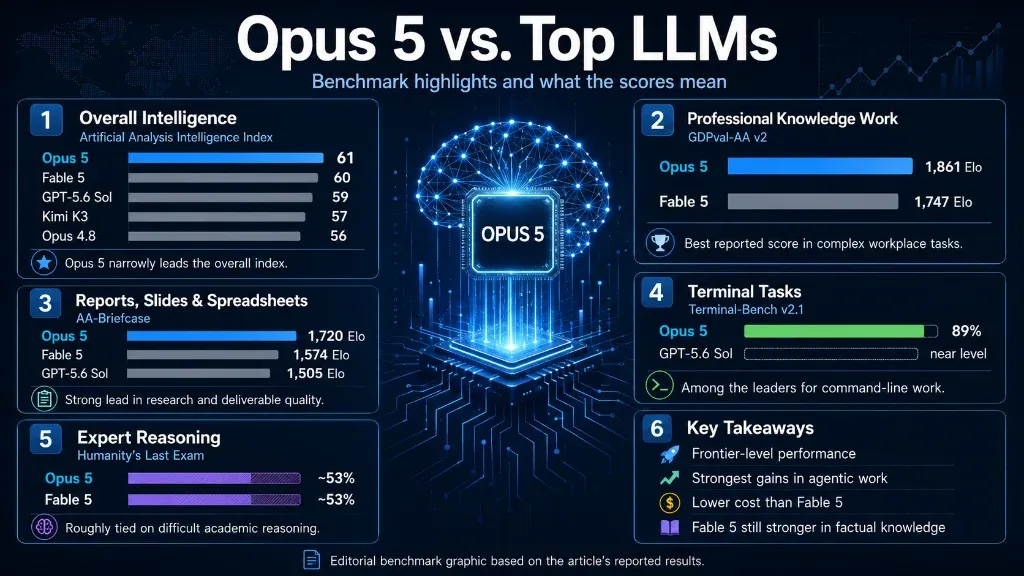
Opus 5 vs. the Top LLMs: Benchmark Comparison at a Glance
The following results compare Claude Opus 5 with several of the world’s highest-performing large language models. Scores can vary according to the reasoning-effort setting, testing environment and agent framework used.
Overall Intelligence
Benchmark: Artificial Analysis Intelligence Index
What it measures:
A collection of evaluations covering advanced reasoning, mathematics, scientific knowledge, instruction following and problem-solving.
Top-model comparison:
Claude Opus 5 Max: 61
Claude Fable 5 Max: 60
GPT-5.6 Sol Max: 59
Kimi K3: 57
Claude Opus 4.8 Max: 56
What it means:
Opus 5 narrowly leads the overall Intelligence Index, although its one-point advantage over Fable 5 means the two models should be considered broadly competitive rather than separated by a large capability gap.
Professional Knowledge Work
Benchmark: GDPval-AA v2
What it measures:
The ability to research information, analyze source material, make professional judgments and produce complete workplace deliverables.
Top-model comparison:
Claude Opus 5 Max: 1,861 Elo
Claude Fable 5 Max: 1,747 Elo
GPT-5.6 Sol Max: More than 100 Elo points behind Opus 5
What it means:
Opus 5 established the highest reported GDPval-AA v2 result, finishing 114 Elo points ahead of Fable 5 and more than 100 points ahead of GPT-5.6 Sol.
The result suggests that Opus 5’s largest advantage may appear during complicated professional assignments rather than simple question-and-answer tasks.
Reports, Presentations and Spreadsheets
Benchmark: AA-Briefcase
What it measures:
Realistic agent-based work involving thousands of source files and deliverables such as reports, presentations, research documents and spreadsheets.
Top-model comparison:
Claude Opus 5 Max: 1,720 Elo
Claude Fable 5 Max: 1,574 Elo
GPT-5.6 Sol Max: 1,505 Elo
What it means:
Opus 5 finished 146 Elo points ahead of Fable 5 and 215 points ahead of GPT-5.6 Sol on this professional-work benchmark.
Its advantage was driven primarily by objective correctness and analytical quality. GPT-5.6 Sol remained highly competitive in the visual presentation quality of completed deliverables.
Agentic Coding
Benchmark: Artificial Analysis Coding Agent Index
What it measures:
The ability of an AI coding agent to understand repositories, navigate development tools, modify multiple files and independently complete software-engineering assignments.
Top-model comparison:
Claude Opus 5 XHigh with Claude Code: Joint first place
GPT-5.6 family: Among the closest leading competitors
Claude Fable 5: Comparable frontier-level coding performance
What it means:
Opus 5 is positioned among the strongest available coding models rather than simply outperforming older Claude releases.
It also recorded the highest result on SWE-Atlas-QnA, one of the evaluations included in the Coding Agent Index.
Terminal and Command-Line Tasks
Benchmark: Terminal-Bench v2.1
What it measures:
The ability to complete difficult technical assignments through a command-line terminal, including navigating files, executing tools and resolving errors.
Top-model comparison:
Claude Opus 5 Max: 89%
GPT-5.6 Sol XHigh: Approximately level with Opus 5
What it means:
Opus 5 is one of the leading terminal-use models, although the result does not establish a decisive advantage over GPT-5.6 Sol.
This benchmark is particularly relevant for coding agents, system-administration assistants and AI tools that operate development environments.
Expert-Level Academic Reasoning
Benchmark: Humanity’s Last Exam
What it measures:
Extremely difficult expert-level questions covering mathematics, science, the humanities and other specialized academic subjects.
Top-model comparison:
Claude Opus 5 Max: Approximately 53%
Claude Fable 5 Max: Approximately level with Opus 5
What it means:
Opus 5 reached Fable-level performance but did not establish a clear lead on this benchmark.
The result shows that Opus 5 is competitive with the largest frontier models in scientific and academic reasoning, but it does not dominate every type of intellectual task.
Factual Knowledge and Hallucinations
Benchmark: AA-Omniscience
What it measures:
Factual knowledge, answer accuracy and whether a model attempts to answer questions when it lacks reliable information.
Top-model comparison:
Claude Fable 5: Outperformed Opus 5
Claude Opus 5: Improved over Opus 4.8 but remained behind Fable 5
What it means:
Opus 5 is not the strongest model in every category. Fable 5 retains an advantage in factual knowledge, while Opus 5 may be more willing to provide an answer when it is uncertain.
Artificial Analysis measured a 50% hallucination rate for Opus 5 on this specific evaluation. That figure applies only to the AA-Omniscience testing methodology and should not be interpreted as the model’s hallucination rate across all everyday uses.
Performance per Dollar
What it measures:
How much benchmark performance a model delivers relative to the cost of running each task.
Average Intelligence Index task cost:
Claude Opus 5 Max: $2.03
Claude Fable 5 Max: $2.75
Claude Opus 4.8 Max: $1.80
Claude Sonnet 5 Max: $1.53
What it means:
Opus 5 is not the cheapest leading model, but it delivers approximately Fable-level intelligence at a substantially lower average cost per benchmark task.
Its strongest selling point is therefore not raw benchmark dominance alone. It is the combination of frontier-level performance, professional agent capabilities and a lower operating cost than Anthropic’s larger Fable 5 model.
Benchmark results should not be treated as guarantees of performance. Scores can change according to reasoning effort, software tools, agent configuration, prompt design and the type of task being completed.
Comments
No comments yet. Be the first to comment!
Leave a Comment