AI Creates Working Viruses for the First Time, Sparking Medical Hope and Biosecurity Fears
 Written by
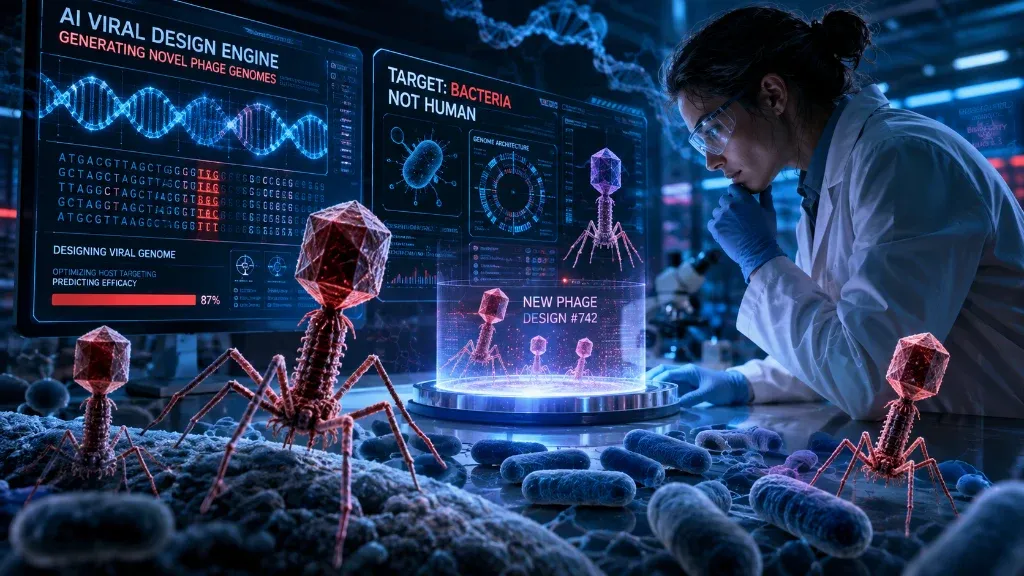
AI Just Created Working Viruses — and Scientists Are Excited, Terrified and Asking, “What Could Possibly Go Wrong?”
Artificial intelligence has officially entered its mad-scientist era.
Researchers have used powerful AI models to design entirely new, functioning viruses—an achievement that could eventually help doctors fight deadly, antibiotic-resistant infections. But biosecurity experts are already sounding the alarm, because once AI learns how to write a working viral genome, the big question becomes: what else could it eventually create?
Before anybody starts building an underground bunker, there is one extremely important detail: these were bacteriophages, meaning viruses that infect bacteria—not people, animals or plants. The researchers tested them against strains of E. coli inside a controlled laboratory. The Guardian reports that cocktails of the AI-designed viruses were able to destroy bacteria that had developed resistance to naturally occurring phages.
AI Wrote the Genetic Instructions
The team used two genome-based artificial intelligence systems called Evo 1 and Evo 2. Think of them like ChatGPT for DNA: instead of predicting the next word in a sentence, the models predict genetic sequences and produce potential biological blueprints.
Scientists asked the AI systems to generate complete genomes inspired by a tiny, heavily studied bacteriophage called ΦX174. Researchers then selected nearly 300 of those proposed genomes, chemically produced the DNA and introduced it into bacteria inside the lab.
Most of the designs were biological duds—but 16 successfully produced viable, self-replicating viruses. Several reportedly competed well against the natural virus, while combinations of the AI-generated phages overcame resistance in multiple strains of E. coli. The original research describes the experiment as the first generative design of viable bacteriophage genomes. The study can be viewed here.
Yes, Humans Still Had to Build Them
To be clear, an AI chatbot did not suddenly grow arms, grab a lab coat and start cooking up viruses by itself.
The AI generated the genetic designs, but human researchers chose which candidates to test, manufactured the DNA and performed the experiments in a controlled laboratory. Still, having AI successfully write an entire functioning viral genome represents a major jump beyond designing a single protein or editing a few genes.
According to the Arc Institute, the phages were designed to target specific bacterial strains without affecting unrelated strains—an important feature for possible future medical treatments.
The Medical Possibilities Are Huge
This technology could become a serious weapon against antibiotic resistance.
Bacteriophages naturally hunt and destroy bacteria, and doctors have occasionally used them in experimental “phage therapy” when antibiotics fail. But bacteria can evolve resistance to phages just as they can become resistant to medication.
AI could potentially help researchers rapidly design new phages tailored to attack a patient’s particular bacterial infection—basically creating a microscopic search-and-destroy squad made to order.
And Here Comes the Terrifying Part
The researchers intentionally focused on small viruses that attack bacteria, and the current work does not show AI creating a virus capable of infecting humans.
But the experiment proves that generative AI can produce a complete genetic blueprint that becomes a functioning virus once humans synthesize it. Biosecurity specialists fear that future systems—especially models trained on dangerous pathogens—could potentially lower the technical barriers to creating harmful biological agents.
Experts are now calling for multiple layers of protection, including restrictions on high-risk biological AI tools, stronger laboratory safety standards and improved screening by companies that manufacture synthetic DNA. Nature has previously reported on the growing debate over whether biological AI systems need tighter controls before their abilities become more advanced and widely available. Read Nature’s biosecurity analysis here.
The Bottom Line
AI has not unleashed a new human plague, and the viruses involved in this research were designed to kill bacteria—not infect people.
But scientists have now crossed a major line: artificial intelligence successfully wrote complete genetic instructions for new viruses that actually worked in the real world.
That could lead to customized treatments for some of the hardest infections on Earth—or, without serious safeguards, hand future bad actors a biological design assistant.
So yes, the breakthrough could save lives. It could also become the opening scene of every science-fiction disaster movie we were told not to worry about.
Comments
No comments yet. Be the first to comment!
Leave a Comment