AI Companies Are Destroying Millions of Old Books—Here’s the Shocking Reason Why
 Written by
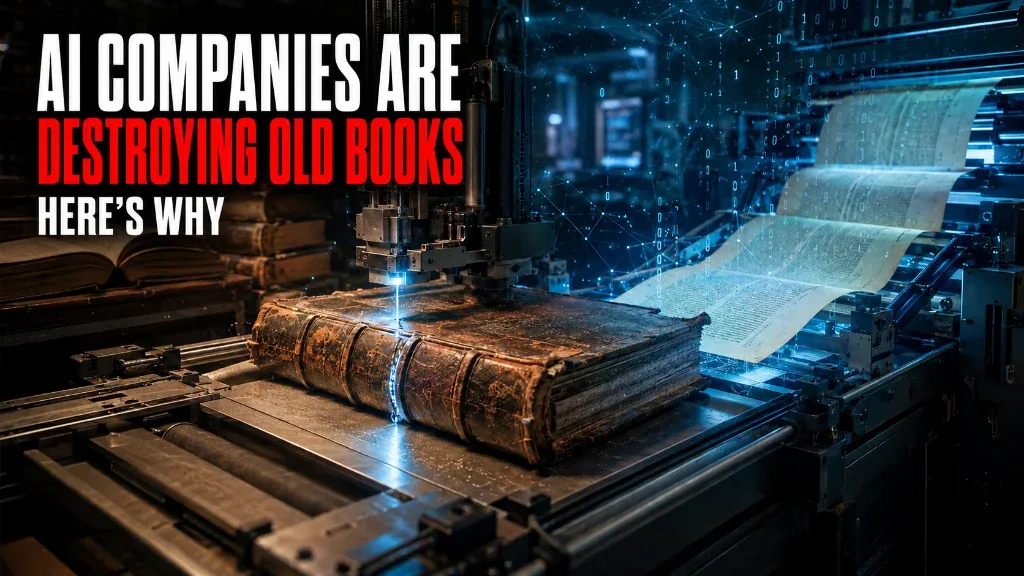
AI Companies Are Buying—and Destroying—Old Books. Here’s the Wild Reason Why
Forget robots taking over the world—AI companies are apparently coming for the bookshelves, too!
Some of Silicon Valley’s biggest artificial-intelligence developers have been snapping up massive quantities of used and out-of-print books, slicing off their bindings, scanning every page and then disposing of what remains. Yes, you read that correctly: actual books are being taken apart so chatbots can get smarter.
But before you picture tech executives feeding priceless Shakespeare first editions into a shredder, there’s an important catch: confirmed reports primarily involve millions of legally purchased used books—not necessarily museum-quality antiques. However, rare-book dealers fear obscure and historically significant titles could still disappear into the same industrial pipeline.
So, Why Destroy the Books?
The answer is speed, baby!
Scanning a bound book page by page is painfully slow. Instead, contractors can slice off the spine, separate the pages and feed them through high-speed scanners. The printed text is converted into searchable digital files that can help train large language models—the systems powering AI chatbots.
Once a book has been disassembled, restoring and rebinding it would be expensive and time-consuming. Many of the damaged copies are therefore recycled or discarded after scanning.
AI developers are especially hungry for books because they contain something the open internet doesn’t always offer: carefully edited, long-form writing created by humans. Books can provide coherent arguments, specialist knowledge and complex storytelling without the spam, copied material and AI-generated “slop” increasingly found online.
Anthropic’s Massive Book Operation
The most thoroughly documented example involves Anthropic, the company behind Claude. According to a federal court ruling, Anthropic purchased millions of physical books, destroyed each printed copy during digitization and kept the resulting files in an internal research library.
U.S. District Judge William Alsup ruled in 2025 that converting those legally purchased books from print to digital was transformative fair use under the specific facts of the case. The company had bought one physical copy and replaced it with one internal digital copy rather than selling or publicly distributing the scan.
That legal victory did not give AI companies a free pass to grab books from anywhere. Anthropic separately faced serious claims involving millions of books downloaded from unauthorized online libraries. The company later agreed to a historic $1.5 billion settlement covering hundreds of thousands of eligible works, without admitting liability.
Booksellers Are Sounding the Alarm
Now the controversy has exploded beyond the courtroom. Booksellers and collectors are asking what happens when bulk buyers target obscure, out-of-print or genuinely rare titles.
A digital scan may preserve the words, but experts say a physical book can contain much more than text. Its binding, paper, handwritten notes, ownership marks and printing errors may hold historical value that a basic scan simply cannot capture.
There’s also a huge difference between a scarce book and a financially valuable one. Plenty of forgotten academic texts and old reference books have very few surviving copies but sell cheaply because demand is low. That makes them easy targets for bulk purchasers—even though destroying several copies could make an already uncommon title harder to find.
At the same time, claims that AI companies are systematically hunting priceless antiques remain difficult to prove. Some firms accused of supplying books to unnamed technology clients say they resell books intact, while Anthropic has denied targeting rare titles through certain booksellers connected to recent speculation.
The Ultimate AI Plot Twist
Here’s the juicy irony: the futuristic AI industry desperately needs material from the past.
As the internet fills with machine-generated content, pre-AI books become especially attractive because they offer guaranteed human writing. Yesterday’s dusty book-bin reject could suddenly become tomorrow’s premium training data.
Legally, companies may be allowed to destroy copies they purchased. Culturally, though, the question is far messier: Should an AI company be permitted to eliminate a physical piece of history simply because it owns that particular copy?
One thing is certain—the next battle over artificial intelligence may not happen inside a computer lab. It could happen in used bookstores, private collections and forgotten library warehouses, where the books nobody cared about are suddenly worth a fortune to the machines.
Comments
No comments yet. Be the first to comment!
Leave a Comment