NVIDIA UNLEASHES NEW “ROBOT BRAIN” — Japan’s Machines Are About to Think for Themselves
 Written by
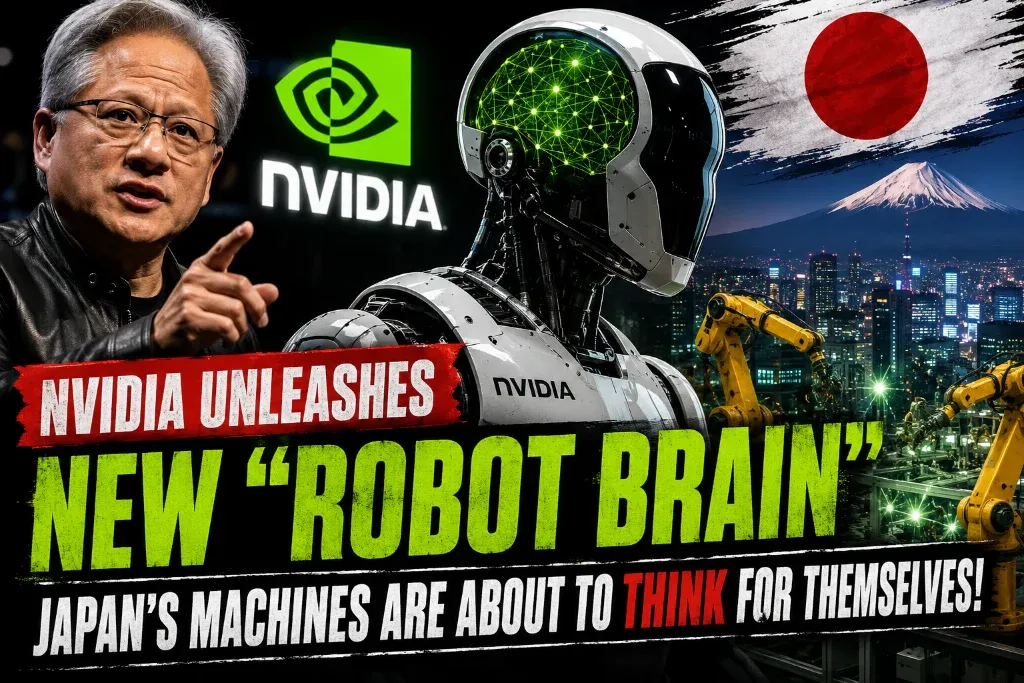
Nvidia is taking the AI battle out of the chatbot window and dropping it straight onto the factory floor — where robots could soon see, think and make decisions without waiting for a human to tell them what to do.
The chip giant has revealed Cosmos 3 Edge, a new artificial-intelligence model built to operate directly inside robots, autonomous machines and other real-world devices.
And Nvidia CEO Jensen Huang is betting that Japan — home to some of the biggest robotics and manufacturing companies on the planet — could become ground zero for this next AI explosion.
THE ROBOTS ARE GETTING A BRAIN UPGRADE
Unlike traditional AI models that sit in enormous data centers answering questions or generating pictures, Cosmos 3 Edge is designed to run closer to the action.
That means machines could potentially analyze what their cameras are seeing, understand their surroundings and decide what to do next — all without constantly sending information back to the cloud.
In plain English: Nvidia wants robots to stop behaving like remote-controlled machines and start reacting more like independent workers.
The technology could eventually be used in factories, warehouses, farms, construction sites, hospitals, roads and even homes.
JAPAN’S TECH HEAVYWEIGHTS JOIN THE PARTY
Nvidia is not attempting this robotic takeover alone.
A massive group of Japanese companies intends to join the Nvidia Cosmos Coalition, including:
- FANUC
- Fujitsu
- Hitachi
- Kawasaki Heavy Industries
- Kubota
- NEC
- SoftBank
- Sony
- Yaskawa Electric
These are not tiny AI startups operating from somebody’s garage. They are major players involved in industrial robots, electronics, machinery, telecommunications and manufacturing.
The companies are expected to contribute technology, research and real-world data as they develop so-called “physical AI” systems.
WHAT THE HECK IS “PHYSICAL AI”?
Physical AI is the industry’s flashy term for artificial intelligence that can understand and interact with the real world.
Instead of merely writing an email or creating an image, a physical AI system could help a robot identify an object, navigate around a person, operate machinery or complete a complicated task inside a changing environment.
Before unleashing these machines into public spaces, developers can also train and test them inside simulated digital environments.
Nvidia says its Cosmos platform can help companies create virtual versions of factories, roads, hospitals and other environments, allowing robots to make their mistakes inside a simulation rather than beside an actual human.
Probably a good place to start.
JENSEN HUANG SAYS JAPAN IS READY
Huang believes Japan’s legendary manufacturing industry gives the country a major advantage in the physical-AI race.
Japan already produces some of the world’s most advanced industrial robots, vehicles and precision machinery. Nvidia now wants to supply the AI models and computing systems capable of making those machines dramatically smarter.
The timing is no accident.
Japan is dealing with an aging population and serious labor shortages, creating growing demand for machines that can safely work alongside people in factories, hospitals and homes.
Supporters believe intelligent robots could fill jobs that companies increasingly struggle to staff.
Critics will undoubtedly ask the much scarier question: What happens to human workers once the machines become good enough to replace them?
NVIDIA IS BUILDING MORE THAN CHATBOTS
The announcement shows Nvidia is aggressively expanding beyond the generative-AI boom that turned its graphics processors into some of the hottest technology on Earth.
The company now wants its chips and software powering autonomous vehicles, industrial robots, security systems and other machines that operate outside traditional computers.
Nvidia has also introduced new Metropolis technology built around Cosmos, allowing developers to create AI-powered camera and vision systems capable of monitoring and understanding activity in physical spaces.
That could include anything from detecting factory problems to managing traffic or monitoring large facilities.
WELCOME TO THE REAL-WORLD AI WAR
For the past few years, the AI arms race has been dominated by chatbots, image generators and enormous language models.
Nvidia’s latest move suggests the next battle may be much more physical.
The winners will not simply build software that can talk. They will build machines that can watch, move, react and work in the real world.
Japan already has the robots.
Nvidia has the AI chips and models.
Now Jensen Huang appears determined to bring the two together — and turn the country’s factories into one enormous testing ground for the robotic future.
The chatbot era was only the warm-up. The machines are about to leave the screen.
Comments
No comments yet. Be the first to comment!
Leave a Comment