Meta Unveils Open-Weight Muse Spark 1.2, Bringing Its Most Powerful AI Model to Developers
 Written by
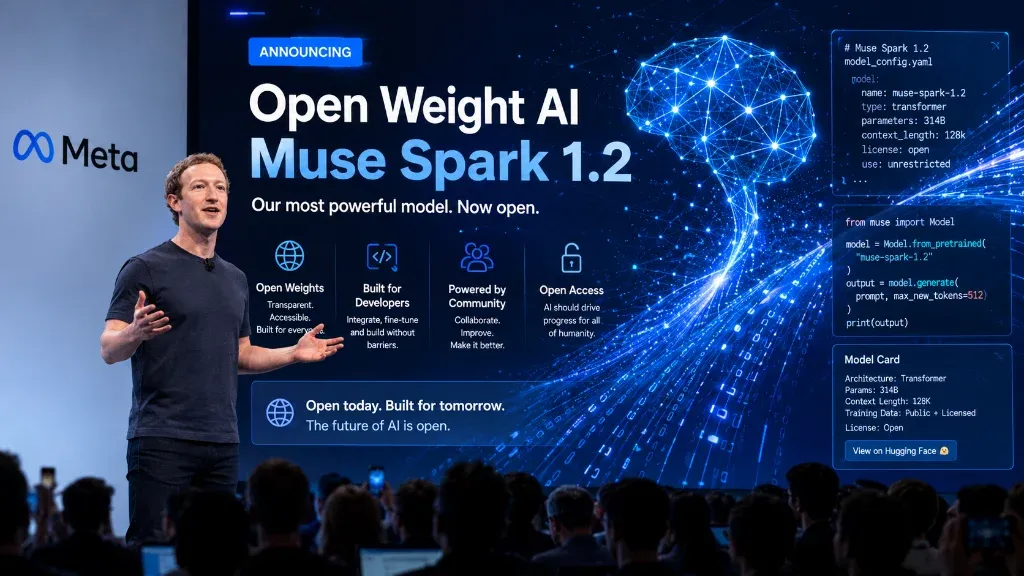
Mark Zuckerberg is opening the AI gates again — and this time Meta is putting one of its biggest weapons on the table.
Meta is preparing to release an open-weight version of Muse Spark 1.2, its latest and most powerful AI model, marking a major return to the company's once-aggressive push to make cutting-edge artificial intelligence available outside Meta's walls.
Translation: developers could soon get considerably more control over the same AI technology powering some of Meta's newest products — instead of being forced to access the brains exclusively through Meta's servers.
Zuck Says AI Shouldn't Belong to a Few Companies
The announcement comes as Zuckerberg is making one thing VERY clear: he doesn't want the future of artificial intelligence controlled by a tiny club of mega-companies.
In a massive new essay laying out Meta's AI vision, Zuck argues that powerful AI should be widely accessible, warning about concentrating too much technological power in the hands of a handful of organizations. Meta says open-weight models can give developers more freedom to customize, study and deploy AI systems themselves.
And Meta isn't only talking.
Muse Glimmer Hits the Scene Too
Alongside the Spark news, Meta launched Muse Glimmer, a smaller open-weight model designed to handle agent-like tasks while being lightweight enough to run on a personal computer equipped with a single graphics card.
Glimmer was trained using technology from the much beefier Muse Spark family — basically giving developers a smaller slice of Meta's high-end AI brain without needing a warehouse full of GPUs.
But “Open Source” Comes With an Asterisk
Here's where things get a little nerdy.
Calling models like this “open source” can be controversial. Meta is primarily talking about releasing the model weights — the numerical parameters the AI learned during training. That doesn't automatically mean Meta is handing over every piece of training data, source code and internal recipe used to create it.
Still, releasing the weights is a BIG deal because it allows outside developers and researchers to download, modify and build products around the model rather than relying entirely on a closed API.
Meta Wants Back in the Open-AI Fight
The move also puts Meta right back into a global battle over who controls powerful AI.
Chinese developers including DeepSeek, Alibaba and Z.ai have been pushing increasingly capable open-weight models, while many leading American AI systems remain primarily closed. Zuckerberg is arguing that American companies need to compete aggressively in the open-model world instead of surrendering that territory overseas.
And Muse Spark 1.2 isn't some science-project model either. Meta already rolled it into Muse Code, its newly launched AI coding agent designed to write, debug and work through lengthy software-engineering tasks.
Zuckerberg's Message: Everybody Gets AI
Meta is betting that the company that helped turn open-weight AI into a mainstream movement can do it again — except now the models are dramatically more capable.
Zuckerberg is essentially planting his flag: instead of putting super-powerful AI behind a velvet rope, Meta wants developers getting their hands dirty with it.
And if Muse Spark 1.2 really lands in developers' hands with the horsepower Meta is promising, the AI arms race may have just gotten a whole lot more crowded.
Source: The New York Times, with additional reporting from Reuters and Meta.
Comments
No comments yet. Be the first to comment!
Leave a Comment